


NASS Crisis: Saraki Stops Move To Challenge His Election
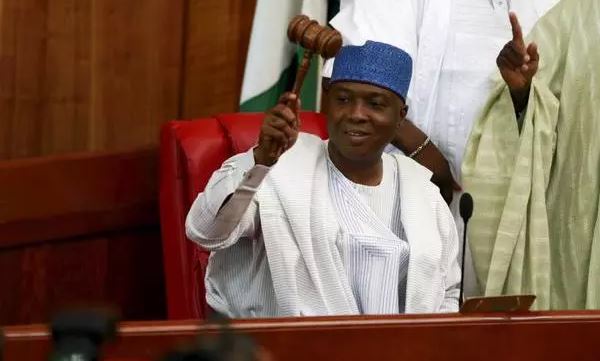
The Senate President Bukola Saraki, Wednesday, blocked an attempt by a senator to question the legality of the June 9 elections of himself and the Deputy Senate President, Ike Ekweremadu.
Mr. Saraki emerged the Senate President unopposed, while Mr. Ekweremadu of the Peoples Democratic Party, was elected deputy Senate President in a controversial election that saw a faction of the ruling All Progressives Congress, APC, forming an a rare alliance with the PDP.
The development has continued to unsettle the APC and the Senate. At its plenary Wednesday, Kabir Marafa, Zamfara State, made an attempt to question the June 9 elections of Messrs Saraki and Ekweremadu.
Mr. Marafa, relying on Order 110 and 3 (e) (i), of the Senate Standing Order, sought to know which of the Order Books (2011 or 2015) was being used to coordinate the election.
He described the 2011 Senate Standing Order as "genuine and authentic" thereby countering the authenticity of the Senate Standing Order 2015. The election of Messrs. Saraki and Ekweremadu was reportedly based on a revised edition of the Senate rules, version 2015.
"I am still referring to the events of the 9th of June, 2015, in this chamber. I have two Order Books and I am running into confusion, and I think there's a need for the President to rule," Mr. Marafa said.
"Which of the Order Books are we going to use to coordinate the activities of this Senate?" he asked.
Mr. Marafa insisted that there was a conflict in the two books as to the procedure that should be taken for election of presiding officers of the senate. He said as a former Senator, he was unaware of the when the 2011 edition of the rules was amended.
Mr. Saraki however ruled Mr. Marafa out of order, thereby stopping what could have meant genesis of his ouster as well as that of Mr. Ekweremadu. Proffering explanation, the Deputy President of the Senate, Ike Ekweremadu, said that from 1999 till date, the Senate had come with its own rules."There was Senate Rule of 1999, 2003, 2007, 2011 and now 2015. The reason is quite simple.
"If you look at Section 64 of the 1999 Constitution it says that the Senate and House of Representatives shall each stand dissolved at the expiration of a period of four years commencing from the date of the first sitting of the house. "So, the implication is that the rule he was referring to ended with the Senate on the 6th of June, 2015," he said.
Cloud Tag: What's trending
Click on a word/phrase to read more about it.
Abubakar Bature Sulu-Gambari Abubakar Kawu Baraje Lukman Oyebanji Fagbemi LEAH Charity Foundation IHS Towers Moronfoye Lafia Aliyu Korasabi Yakub Lai Gobir Ibrahim Bio Abubakar B.M Durosinlohun Atiku Adijat Adebiyi Bashiru Makama New Naira Notes Oluwatoyin Lukman Kwara Polytechnic Kannike Tinubu Bureau Of Lands Makama Of Kaiama Wahab Olasupo Egbewole KWASEIC NAWOJ Rice Farmers Association Of Nigeria Mohammed Kamaludeen Florence Saraki REO CAKES Plat Technologies Limited Bolakale Saka Egbejila March 28 Ilorin Omar Gambari Adisa Logun Bahago Abdulrasheed Akogun IESA Tafida Ahman Pategi University Elesie Of Esie Afolabi-Oshatimehin Adenike Harriet Kwara Metro Park National Pilot Abdulkareem Alabi Oke Sunna Kayode Yusuf Boko Haram Kale Kawu Oasis Muslim Care Foundation Salihu Yahaya Joseph Alex Offorjama Alabi Lawal Abubakar Baba Majlis For Sadaqah, Zakat And Waqf Abdulmumini AbdulRazaq Ahmed Shuaib Buranga First Lady Ajibike Katibi Wahab Issa Moji Makanjuola Lotus Bank Toun Okewale-Sonaiya National Broadcasting Commission Geri-Alimi Split Diamond Interchange Adeniyi Ojo Idris Garba Ileloke Haashim Initiative For Community Advancement Ridwan Agboola Aliyu Sabi Sodiya Curfew Aliyu Kora-Sabi Zubair Folorunsho Erubu Ilorin Curfew S.O. Opowoye Emir Of Lafiagi