


OPINION: Saraki's made in Nigeria. By Emeka Omeihe
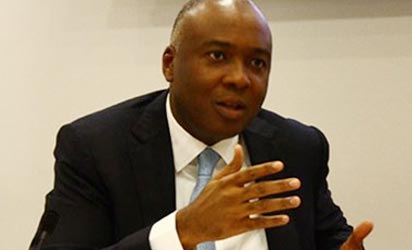
Senate President, Bukola Saraki had very kind words for the Nigerian Army last week over its decision to purchase 50,000 pairs of shoes from a local manufacturer in Aba. He sees the decision as ample evidence of the crucial role a truly national institution such as the Nigeria Army could play in ending the prevailing economic recession in the country.
For this patriotic example, Saraki urged other military and paramilitary establishments to emulate the army even as he also praised the Nigerian Air force for the cooperation it entered into with a local spare parts manufacturing company to produce some airplane parts for its use. The Senate President attributed the new direction to the amendment by the Senate of the Public Procurement Act in June this year.
The new law compels Ministries, Agencies and Departments (MDAs) to compulsorily give preference to goods and services which can be sourced locally. Saraki believes that patronage of Nigerian made goods was the panacea for the economic problems that have overtime held this country down. In this, he spoke the minds of many.
It is heart-warming that the Nigerian Army is now patronizing made in Nigeria shoes while the Air Force is forging some cooperation with a local company for the production of spare parts for the use of its fleet. That is the way it should be. It has long been recognized that our taste for what is foreign even when there are good alternatives locally has been the greatest disincentive to investment and development.
Government response to this penchant for conspicuous consumption had fluctuated between outright ban on some of these goods and services and some form of restriction. Just recently, the Central Bank of Nigeria (CBN) banned some items from being funded from the official foreign exchange market. The essence was to discourage the importation of these goods and stimulate the production and consumption of locally produced ones.
But with the world as a global village and many African countries signatories to World Trade Organization WTO treaties, such restrictions are no longer in vogue. They run in conflict with trade liberalization which is based on the premise that each country will be able to exploit its position of comparative advantage once free and fair trade regime has been implemented.
But as a primary producer that depends almost solely on a mono cultural economy for its foreign exchange earnings, trade liberalization has had adverse toll on the nation’s economy as our citizens depend largely on imported goods and services, thus exerting undue pressure on our foreign earnings.
Our local manufacturers have had to contend with stiff competition from foreign manufacturers in the face of hash business environment. Faced with stiff competition and sometimes better produced goods, our people have not hidden their preferences for the foreign produced goods and services. If such a trend is allowed an unfettered reign, our nation would be worse for it. Thus, the allure of the campaign to attune the psyche of our people to patronize locally produced goods and services.
The overriding idea is not only to conserve foreign exchange usually depleted in the importation of goods that have local alternatives, but more importantly, to enable local industries grow and offer employment to our army of job seeking youths.
But despite years of preachment and pontification, not much gain has been made in this direction. Even the government that purports to lead the way in this re-orientation drive has come out the worst culprit for serially flouting it. Instances abound where governors have gone abroad to import school uniforms, chairs and other materials when there are a surfeit of those items in very good quality locally.
Such governors are bad examples and therefore cannot be expected to act as armour bearers in the campaign to make our people patronize made in Nigeria goods. Needless to talk of the millions of jobs they have created for foreign companies while denying their constituents such job opportunities. The same goes for government ministries, agencies and departments.
Perhaps, the incongruity between policy directives of the government and the actions of its officials moved the Senate to amend the Public Procurement Act, so as to compel these agencies give preference to local manufacturers where viable alternatives exist. Saraki would therefore wish to appropriate credit for the decision of the army and the air force to look inwards for some goods and services. He is entitled to his opinion though the issue predates the current Senate.
The idea the Senate President is celebrating was the brainchild of the Yar’Adua administration. During that era, the then minister of commerce and industry, Chief Achike Udenwa had rolled out an elaborate programme for the sensitization of Nigerians for the patronage of made in Nigeria goods.
In those sensitization meetings, stakeholders overwhelmingly embraced the idea as it would in part address some of the problems that had over time militated against industrial development. The campaign was launched with much fanfare in 2009. And at the launch, Yar’Adua who was represented by his deputy, Goodluck Jonathan had announced a number of measures to promote made in Nigeria goods and stimulate domestic production.
He banned the serving of foreign tea and all manner beverages in government offices and functions. That was not all. He directed that henceforth, all contractors must give priority to Nigerian made products. In addition, all uniforms and boots of the armed forces must be sourced locally. It is now seven years that directive was given.
And if the armed forces are just aligning themselves to that order seven years on, it only illustrates most glaringly, the yawning gap between policy pronouncement and their implementation. That is perhaps why Saraki is beating his chest for the credit of strengthening the procurement law. The coincidence of the purchases by the army may well be a consequence of the Senate action.
Now it has been given the force of law, it is hoped that all ministries, agencies and departments of government must give priority to it in their procurement plans. That should be the starting point for the Minister of Budget and National Planning, Udo Udoma who had indicated government’s plan to embark on the campaign to encourage Nigerians buy made in Nigeria goods.
With the government taking the lead, it will become much easier for the ordinary people to follow. Example they say, is better than precept. It had hitherto been contradictory for the government to be parroting the campaign when in all its actions it did the contrary. We also expect to see in the days ahead the arraignment in court of law, institutions that flout the new procurement law so as to serve as a deterrent to prospective offenders.
The sentiments expressed by Saraki on patronage of locally made goods being the panacea to our underdevelopment are in order. That idea had long been shared by previous regimes. But the necessary incentives and support infrastructure that would catalyze industrial development have all been lacking. So, in this drive to get our people consume what we produce locally, the environment must be made business friendly to enable manufacturers perfect on their production and withstand the stiff competition arising from trade liberalization.
Cloud Tag: What's trending
Click on a word/phrase to read more about it.
Baakini Shoprite Muhammed Akanbi Quran Bola Tinubu Yahaya A Paniyaro Kwara 2015 Bio Ibrahim John Olajide Adedipe Ibraheem Adeola Katibi Doyin Group Simeon Sayomi Abdulkadir Remi Hawawu IYA YUSUF Abiodun Abdulkareem Jaigbade Alao Borgu Dunmade Okin Biscuit Michael Imoudu National Institute For Labour Studies Michael Ologundea Valsolar Consortium Roseline Oni Aremu Yusuf Amuda Gobir Wahab Femi Agbaje Dankaka Ganmo Habeeb Abdullahi Al-Ilory Tunde Mukaila Mustapha TESCOM 2025 State Bureau Of Internal Revenue Earlyon Technologies Alabere Valsolar Consultoria National Association Of Nigerian Students Suleiman Abubakar Harrison Osauwagboe Ajase-Ipo Pius Abioje Abdullahi G. Mohammad Ayekale Agbarere Bolakale Kawu Erubu Obasanjo IQRA College Baboko Primary School Abubakar Kawu Baraje Sidikat Alaya Coalition Of Kwara North Groups CCEPE Ayoade Akinnibosun Oba Abu Olubukola Kifayat Adedeji Labaeka Aasiyat Bello Oyedepo FERMA Muhammed Taofeeq Abdulrazaq Moshood Bakare Sa\'ad Alanamu Rueben Parejo Ahmed Mohammed Rifun Moshood Kashimawo Abiola Hassan A. Saliu Kwara State Printing And Publishing Corporation Abdulkarim Adisa Sa\'adu Salahu Chief Imam Of Omu-Aran Adijat Adebiyi Charles Ibitoye Abdulkadir Bolakale Sakariyah Mufutau Gbadamosi Esuwoye Olaitan Adefila SARS Ojuekun Binta Abubakar Mora Osinbajo