


Move Beyond Classrooms, Gambari Urges Scholars to Bridge Knowledge Gap in Policy
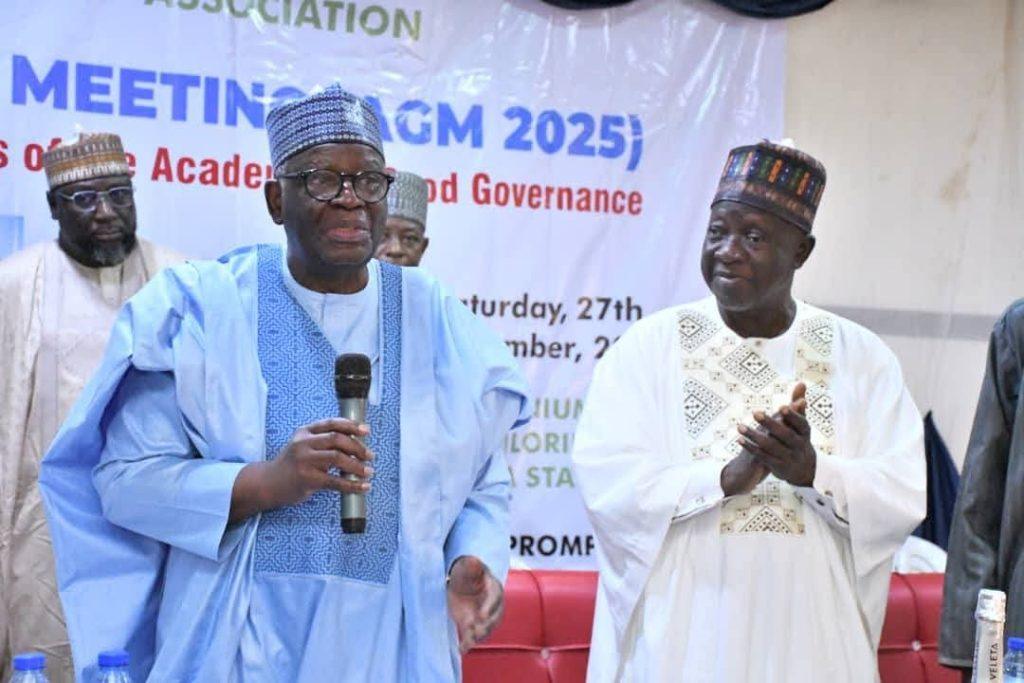
Professor Ibrahim Gambari, former Chief of Staff to the President and a distinguished diplomat, has challenged Nigerian academics to move beyond theoretical research and actively participate in governance and national stability.
Speaking over the weekend at the 7th Annual General Meeting of the Association of Ilorin Emirate Professors (AIEP), Gambari warned that the silence of scholars in the face of institutional decline is no longer sustainable.
Delivering a lecture titled "Roles and Responsibilities of Academia in Good Governance," the scholar-diplomat argued that high-level research often remains trapped on library shelves rather than influencing public policy.
He urged professors to serve as the "intellectual conscience" of the nation, providing evidence-based solutions to complex challenges like digital governance, climate resilience, and economic reforms.
The event, held in Ilorin, was chaired by Professor Abdulganiyu Ambali, former Vice Chancellor of the University of Ilorin. In his welcome address, the President of the Association, Professor Abdulkabir Hussain Solihu, reinforced Gambari's message, announcing the establishment of a new committee on "Good Governance and Citizens' Civic Rights" to facilitate public dialogue and ethical guidance in leadership.
Professor Gambari urged scholars to caution the political leaders that power is easily lost when it is not shared, warning governments at all levels against taking communities for granted.
He cited Kwara's political history as evidence, recalling how the ruling establishment in the old Ilorin Province lost control in 1957 to the Ilorin Talaka Parap?? through democratic elections, the defeat of Governor Adamu Atta in 1983, and the 2019 "O to g?" movement that swept the opposition APC to victory across state, national, gubernatorial, and presidential polls.
Gambari also warned that Nigeria's youthful population, growing social pressures and governance deficits require a new approach from universities and research institutions, particularly in evidence-based policymaking, civic engagement and capacity building.
He identified key areas where academia must intervene, including policy testing, legislative research, public sector training, institutional reforms, anti-corruption frameworks, digital governance, crisis management and climate resilience .
According to him, old methods of engagement are no longer effective in a society driven by technology, bold youth activism and rapid political change, insisting that academics must maintain independence while "speaking truth to power".
He further outlined core governance values such as ethics, transparency, accountability, rule of law, participation, equity, efficiency and sustainability, arguing that governance becomes legitimate only when these principles are visible and measurable to citizens .
Placing Nigeria's governance struggle within a broader international framework, Gambari said today's world is marked by geopolitical instability, technological disruption, climate change and resurging nationalism, all of which place governments under pressure to make difficult choices with scarce resources.
He noted that globally, successful democracies rely heavily on academic institutions for policy clarity, data-driven decisions and ethical guidance, urging Nigerian scholars to adopt similar roles to prevent social breakdown and distrust in public institutions.
Gambari also called for stronger interdisciplinary collaboration across sciences, humanities, social sciences and technology, arguing that modern governance challenges are too complex for single-discipline solutions.
He urged Nigerian academics to leave their "ivory towers" and engage the public through constructive dialogue, while remaining vigilant against political compromise and loss of intellectual integrity.
"When this ecosystem between academia and governance is in balance, we see policy effectiveness, democratic accountability and social development. When it is not, the result is chaos, distrust and societal breakdown," he warned.
The lecture concluded with a call for sustained scholarly engagement at both national and international levels to strengthen governance systems and restore public trust in leadership.
Cloud Tag: What's trending
Click on a word/phrase to read more about it.
Sola Saraki Educational Foundation Ilorin Metro Park Babajide Ajayi ASUU Ebola Oko Shehu Raheem Adaramaja Fatai Adeniyi Garba KSIRS John Mayokun Dada Lanre Issa Onilu Omotoso Musa Ibrahim Orire Adewuyi Funmilayo Alfa Modibo Belgore Bashiru Makama Damilola Yusuf Adelodun Yusuf Abdulraheem International Aviation College Mohammed Halidu KWASIEC Offa Descendants Union Babatunde Ajeigbe Metro Park Kwara State Council Of Chiefs Onilupeju Of Ilupeju Ladi Hassan Saka Keji Odolaye Aremu Turaki Of Ilorin Olatinwo John Olajide Adedipe Ajakaye Shola Odetundun UTME Olabode George Towoju CCEPE Yahaya Abdulkareem Babaita Fatimat Saliu Photo News Dankaka Revenue Court Ben Duntoye Hassan Abdulazeez Elewu Odo-Owa Kumbi Titilope Wole Oke Abdulmalik Bashir Mopelola Risikatullahi Musa Aibinu PAACO-PCL Consortium Olatunde Jare Kola Shittu Atunwa Senate President Olatunji Abdulmumeen Omar Gambari Sidikat Akaje Saka Abimbola Isau Raji AbdulRasaq Alimi Abdulrazaq School Of Nursing V.O. Abioye Soffiyyallah Kamaldeen LAK Jimoh Dar-Al-Handasah Consultants Ltd Mohammed Kamaludeen Budo Egba Baakini Mufti Of Ilorin Agboola Abdulraheem Arca Santa Halimah Perogi Colleges Of Education Academic Staff Union Offorjama Aremu Odolaye Joseph Daudu Bayo Ajia