


Opinion: HRH Ibrahim Sulu-Gambari: 20 years on the Ilorin throne. By Is'haq Modibbo Kawu
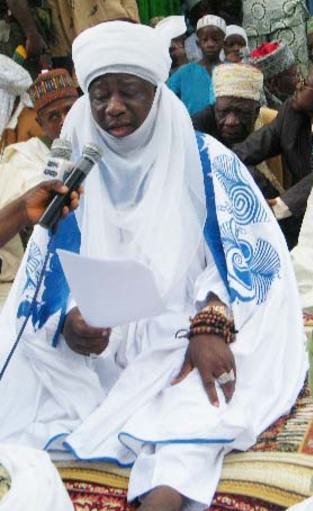
AT the eleventh hour of the eleventh day of the eleventh month, twenty years ago, in 1995, Hon. Justice Ibrahim Gambari, was officially instituted as the eleventh Fulani Emir of Ilorin. His Royal Highness came to the throne eminently qualified and prepared for the position.
He was already a highly educated achiever who had a very modernising perspective and a cosmopolitan world outlook, because of an education, which took him to the best schools at home and abroad. He was an accomplished jurist who presided at the Ibadan Division of the Court of Appeal and had become a very influential member of the Nigerian elite.
A man of many levels of friendship and interests, then Justice Gambari had been a member of the board of the Nigerian football federation and a lover of sports who played lawn tennis with a great deal of passion. He was for many years Ciroman Ilorin, and was clearly prepared for the next step to become Emir, which eventually came to him with the death of his Uncle, the tenth Emir.
HRH Ibrahim Gambari ascended the throne at a point of very fast-paced changes in the world, in Nigeria and inside Ilorin town. The political situation in the country was very tense, against the backdrop of the annulment of the June 12, 1993 elections; the national resentment in the aftermath; return of military dictatorship and the years of the struggle for democracy with a rejection of the entire authoritarian baggage of military dictatorship.
Military dictatorship
Alhaji Ibrahim Sulu-Gambari had to combine a modernising vision with a deft ability to preserve the very best elements of the fast eroding traditional values in a community that was similarly undergoing remarkable changes. And in the past twenty years, Ilorin has undergone tremendous changes: there is the incredible demographic revolution, as in all of Nigeria, where the community's population has become very, very young.
The educational campaigns of the past couple of decades have collectively led to an explosion in schools attendance in the Ilorin Emirate. This is an Emirate that combines an increasingly populated urban complexity with a rapidly decaying, often restive rural component, where there is also a growing consciousness of self.
Return to Civil rule: The return to civil rule in 1999, led to the reopening of old fissures within the subsoil of Ilorin history, which tested very severely, the relationship between the new civilian government of the late Governor Muhammed Lawal, and the Emirate structure in the city.
Two of the more resilient elements of the Ilorin identity won out in the long run; these were acceptance of the Emirate structure and fidelity to Islam, both of which were always interwoven in the Ilorin consciousness, and which have kept a community of multi-ethnic identities together, for over two hundred years. The community, including and especially its elites, rallied around the Emir and on a note of near finality, the long-standing Saraki political machinery was finally able to ride on the back of the aspirations of the Ilorin people, to impose a stranglehold on the political, economic and even the cultural affairs of the Ilorin community, since 2003.
The past twelve years, since 2003, have been under the almost-total control of a family's hegemony that has had a far more negative effect on the communal ethos of the Ilorin community, than at any other period in the past fifty-five years of Nigerian independence. At its heart, has been the institution of the Saraki personality cult, which reached even greater heights of absurdity, when the younger Saraki, Bukola, became the ultimate controller of politics; dispenser of fortune; the one that offers placements and sharply administers demotions within politics and the bureaucracy; and the 'infallible godfather' determining administration and application of state financial resources; and maybe, as people are now beginning to discover, the richest individual ever, in the community!
The majority of the people in the community,are the young who have grown into adulthood over the past twelve years; they only know the arrested development; governance-as-a-lie; deceit; hypocrisy; sycophancy; groveling surrender; abuse and violence associated with the dictatorial hegemony in the state today. Within this ambience, it has not often been easy even for our highly revered Emir, His Royal Highness (HRH), Ibrahim Sulu-Gambari,to operate with effectiveness, as the father of all.
Long before 2003, such outstanding sons of the community like the late General Abdulkareem Adisa, for example, gave a lot to the community, including the modern Eid praying ground; yet, even his name won't be remembered in prayers in that praying ground today. The suffocating agendas of the hegemony have taken centre stage of community life, almost as if there was no community before the controlling political family came to Ilorin; and the hegemon's pursuit of a personal political ambition today, suborns practically every institution of the Ilorin community, including even the values of the Emirate system. The overriding ambition of an individual portends great danger for future continuing cohesiveness in our community.
Huge population of young: The huge population of young people in the community is unable to get meaningfully engaged in an economy that is barely functional. An entrepreneurial spirit has not flowered as much as could, because of the close control of finance within a narrow circle in the city and state.
Politics is everything, since it seems to be the most ready way to find some amount of success, but not all can become commissioners; special advisers or assistants; there has therefore grown a huge reservoir of lumpen youth, employed as thugs and toughies, and are in the entourage of the political hegemony in the state. It is amongst these that come those used to snatch or stuff ballot boxes during elections or to administer violence against political opponents of the hegemony; and it is from amongst them that came those who went on a rampage of killings and destruction of property in Ilorin, a few months back.
Hegemony's mismanagement
There is also a structure of deepening religious fundamentalism within a section of the youth in the community. And the fact that there is generalised deepening of poverty in the community, which is the direct result of the hegemony's mismanagement of state resources, has also played into the manipulative, divisive and often violent politics of the period since 2003.
The strongest current here has overwhelmingly been negative, yet those within the circles of the hegemony have built personal houses, petrol stations, hotels and guesthouses and event centres, as expressions of the crumbs they earned from groveling servitude to the hegemon.
But the Emirate structure has over the past two hundred years provided an ambience of peace and general respect for diversity. Ilorin has therefore gained a lot of investments and an inflow of people fleeing more volatile areas of Nigeria. The Emir of Ilorin consistently speaks for the maintenance of that unique aspect of communal existence and even the bleak picture associated with hegemonic politics has, thankfully, been unable to destroy the welcoming and generally peaceful nature of the Ilorin community. And as a state capital, Ilorin has grown as a seat of administration, centre of culture and learning with universities, colleges of education, polytechnic, Islamiyyas and Madrasas; shopping complexes, even vehicular gridlock on roads and other associated examples of the modernity, that Emir Ibrahim Sulu-Gambari has always wanted in the community.
Successes of sons and daughters: And the successes that many sons and daughters of the community have made in professions in many parts of the world are also a hallmark of the developments witnessed in the past twenty years in Ilorin. His Highness Alhaji Ibrahim Sulu-Gambari has a lot to be happy about in his twenty years on our forefathers' throne. Going forwards, balancing the dialectic of Ilorin's traditional ethos and the complexities of modernity, will continue to engage Emir Ibrahim Sulu-Gambari's leadership acumen.
He will also have to return to the starting point of being the father of all in the community. His Highness should re-invigorate the structures of leadership to ensure that he re-connects firmly with all of our people and the aspirations of all our elites, not just the interests and political ambition of the leading politician in the community today. The people need him as a rallying point as much as he needs the people's love and loyalty. That is our history! Happy Twentieth Anniversary! Allah ya ja zaminin Mai Martaba, Emir of Ilorin, Alhaji Ibrahim Sulu-Gambari! Amin.
Cloud Tag: What's trending
Click on a word/phrase to read more about it.
Toyin Saraki Maimunat Oniyangi Simeon Sule Ajibola Segun Adeniyi CBT Okeose Christian Cementary Kehinde Boyede Ibrahim Gambari Centre For Digital Economy Valsolar Consultoria Saba Jibril Aminat Omodara Nigeria Foundation For Artificial Intelligence Kwara University Of Education Tsaragi/Share College Of Arabic And Islamic Legal Studies Kisira Demola Banu Laolu Saraki Saka Saadu Haashim Initiative For Community Advancement Abdulrazaq Solihudeen Ilorin Talaka Parapo Suleiman Mora Omar Lola Olabayo Baba Issa Wahab Abayawo Aro Yahaya Abdulrahman Abdulrazak Ajakaye Naira Redesign Umar Ayinla Saro Bello Taoheed Abubakar Oloriegbe Countryside Emerging Leaders Fellowship IDPU Abdulkadir Orire Alimi Abdulrazaq Bareke Umar Bayo Abdulwahab Muhammad Ghali Alaaya Kwara State Television (KWTV) Coronavirus Shuaib Jawondo Belgore LABTOP Baruba Computer Based Test African Democratic Congress Temi Kolawole Eleja Hydro-electric Power Producing Areas Development Commission Oba Of Jebba Oyedun Juliana Funke Umar Sanda Yusuf Shuaib Abdulkadir Medinat Folorunsho Salman Facemasks Sarafadeen Kayode Akorede KWASSIP Sambo Murtala Yoonus Lawal Y.A. Abdulkareem Ganmo Hussein Oloyede Afolayan Ajase-Ipo Kwara Kwarareports Laboratory-to-Product Kwara Metro Park Tunji Oyawoye Abiodun Musa Aibinu Monthly Sanitation Turaki Of Ilorin Ayodele Shittu Summit University